
We know startups are inherently risky and have a high failure rate, mostly due to the fact that venture funding is so hard to secure.
In fact, less than 0.05% receiving venture funding.
As a result, approximately 20% of new Australian businesses fail in the first year – and up to 60% do not survive beyond five years (Australian Bureau of Statistics).
So, if we told you that one Australian startup managed to raise over $150 million, you’d probably say, ‘No way’!
But that’s exactly what Samsara Eco achieved.
Plastic Waste Crisis
This unique and innovative enterprise was launched in 2021 in partnership with the Australian National University (ANU), Main Sequence, and the Woolworths Group.
Founder and CEO, Paul Riley, was then an Entrepreneur in Residence at deep tech venture capital firm Main Sequence, tasked with finding a breakthrough solution to the plastic waste crisis.
Around the same time, Vanessa Vongsouthi was completing her PhD at ANU, researching how engineered proteins could accelerate the breakdown of plastics.
“Paul came across our work in the University’s magazine, and the rest is history,” said Vanessa, who is Samsara Eco’s Research Founder and Head of Bioengineering and Protein Design.
Achieving Circularity
“Almost five years on, we’ve grown into a team of around 80 people across Australia, North America, Asia, and Europe, working with some of the world’s leading brands to achieve circularity, turning waste into new, recycled materials that are better for the planet,” she said.
Samsara Eco aims to end plastic waste and displace fossil fuels from its production for a more sustainable future.
“Most plastic and textiles currently end up in landfills or are incinerated at end of life. This cycle fuels the continual need to create more virgin plastic from carbon-intensive fossil fuels,” said Vanessa.
“We’re aiming to flip this linear take-make-waste model on its head by creating true circular systems for plastics. Instead of plastics or textiles going to landfill at their end-of-life, they are continually recycled and remade into new products again and again.
Ending Waste
“We are just one leg of the table of change here. Consumption habits need to change with a greater focus on mindful consumption and durability. Regulations to increase recycled content and decrease virgin plastic production also play a role. But we’re proud of the progress we’ve made to date and will continue dedicating our days to end waste and displace fossil fuels.”
Samsara Eco is not just innovative in the way it approaches recycling – but also in its approach to venture funding.
The enterprise raised that astonishing amount of money from its ever-growing supporter base, including venture capitalists, Main Sequence, Temasek, Breakthrough Vic, Greycroft, DCVC, CEFC, lululemon, Hitachi Ventures, Titanium Ventures, and Wollemi.
In September this year, Samsara Eco achieved a significant milestone, building and opening Jerrabomberra, its first plant and new headquarters for the 80-plus team.
Finding Recycling Solutions
“The new facility exponentially increases our ability to produce virgin-identical, low-carbon circular materials like recycled nylon 6,6 and polyester at scale,” Vanessa said.
“The plant houses our enzymatic recycling technology, EosEco, and expands our enzyme production facilities, so we can further build out our proprietary enzyme discovery and development platform to find recycling solutions for a broader range of plastics.
“We also host world-first research with partners, including finding recycling solutions for the likes of spandex with The LYCRA Company, and our collaboration with Deakin University’s Recycling and Clean Energy Commercialisation Hub.”
This level of interest in what the business is doing is to be expected, as Samsara Eco is recycling the unrecyclable!
“Right now, about 9% of the plastic produced globally is recycled. That drops down to less than 1% for textiles. The reality is, most of these materials are mixed with other types of plastics or fibres, and are coloured and dyed, which can’t be recycled with traditional mechanical recycling.
Reducing Reliance on Fossil Fuels
“Largely, only the cleanest, clearest and pure plastic can be recycled. And even then, with each cycle of this process, the plastic loses quality and structural integrity, and it must be injected with increasing amounts of virgin plastic until it eventually meets the same fate as the rest of our plastic waste.
“For textiles, the quality of recycled materials is often not good enough to be used in creating new textiles, so they are downcycled, perpetuating the need for new fossil fuels to make products.
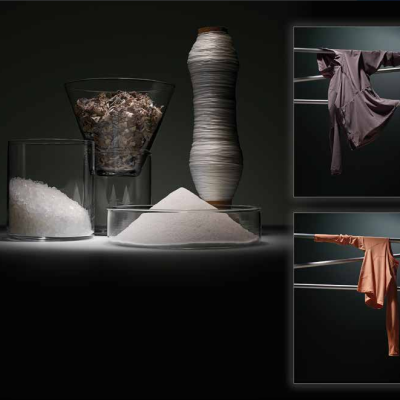
“By breaking down plastics into their original building blocks and removing impurities, we can process mixed and coloured plastics and textiles that are typically unrecyclable and create virgin-identical recycled materials that seamlessly integrate into existing supply chains. This is how we’ll create true circularity to end plastic waste and reduce the world’s reliance on fossil fuels.”
There is no doubt that Samsara Eco is an organisation to watch closely as they go from strength to strength. Great things are in the pipeline, including an international commercial facility in 2028.
The business is also working closely with Canadian multinational athletic apparel retailer, Lululemon. They recently signed a 10-year agreement to source recycled raw materials, underscoring lululemon’s long-term commitment to help build a circular ecosystem for its high-performance products.
This multi-year agreement could see Samsara Eco’s materials support approximately 20% of lululemon’s overall fibres portfolio and advance its progress towards making more products with preferred materials by 2030.
To find out more about these exciting innovations, visit www.samsaraeco.com